
Choosing the Right Wound Dressing for Home Care
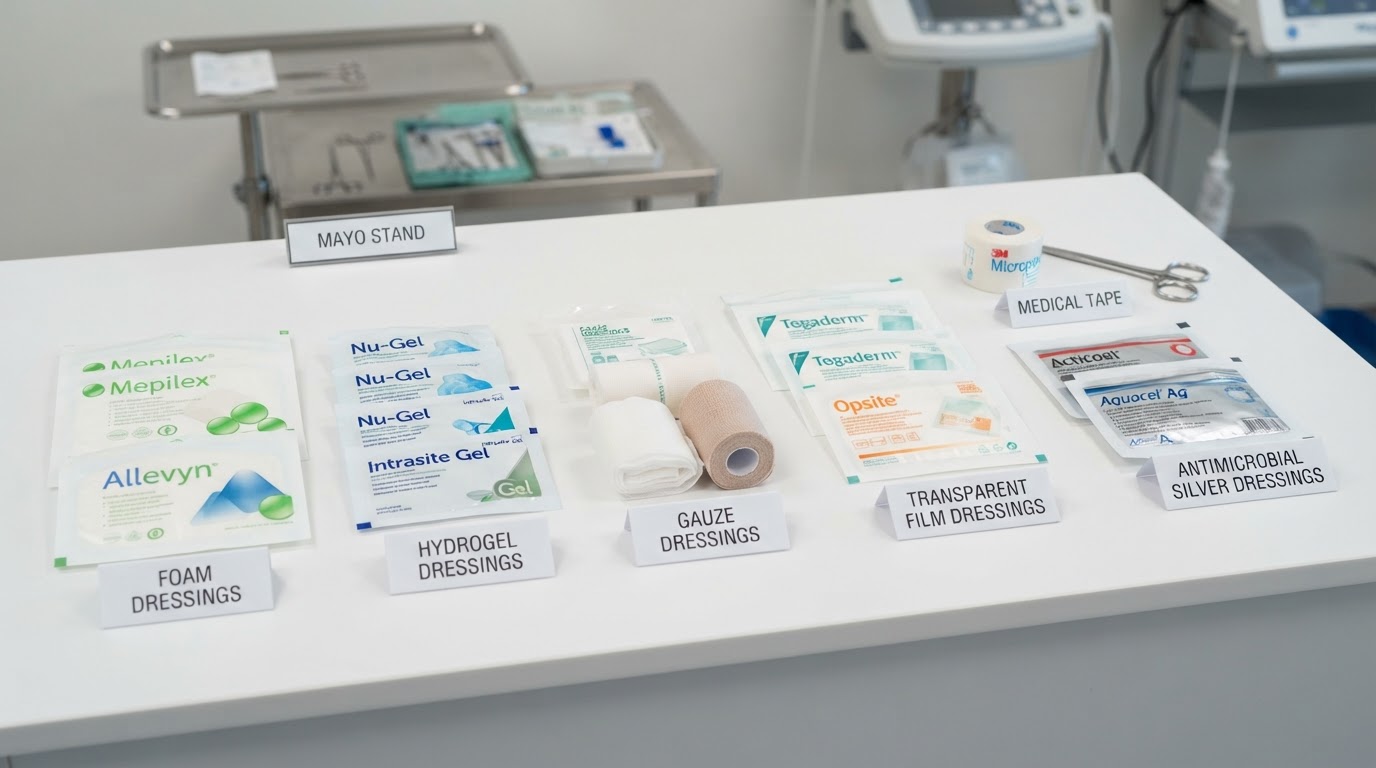
Foam, hydrogel, alginate, or film? Understanding which dressing your clinician chooses and why it matters for your healing at home in Broward County.
Content reviewed for accuracy by our clinical network • Last updated: August 2026
Why the Right Dressing Matters More Than You Think
When a licensed wound care nurse visits your home, one of the most important decisions they make happens before they ever touch the wound: choosing the dressing. It is not a one-size-fits-all choice. The dressing your clinician selects on any given day depends on how much the wound is draining, whether infection is present, how deep the wound goes, and what stage of healing the tissue is in. A dressing that was perfect last week may be the wrong choice this week because the wound has changed.
Many patients and caregivers are surprised to learn that there are dozens of distinct dressing categories, each engineered for a specific clinical purpose. Using the wrong type can stall healing, trap bacteria against the wound bed, or strip away fragile new tissue each time it is changed. Understanding the basics of what your nurse is applying — and why — helps you become an active participant in your own recovery and gives you the vocabulary to ask informed questions during each visit.
This guide breaks down the most common dressing types used in home wound care across Broward County, explains when and why each is chosen, and covers what you should watch for between visits. You do not need to memorize every product name, but knowing the general categories will help you feel more confident about the care plan your clinician builds for you.
The Goal of Any Wound Dressing
Before diving into specific types, it helps to understand what every dressing is trying to accomplish. A wound dressing is not just a cover. It is a carefully chosen tool designed to create the optimal environment for your body to repair itself. The core goals are consistent across nearly every dressing category.
First, the dressing must maintain a moist wound environment. This surprises many people who grew up being told that a wound needs to "dry out and scab over." Decades of clinical research have shown that wounds heal faster — and with less scarring — in a moist environment where cells can migrate across the wound bed efficiently. A dry scab actually acts as a barrier to the cells trying to close the wound. The art of dressing selection is maintaining that moisture balance: not too wet, which causes the surrounding skin to break down, and not too dry, which stalls the healing process.
Second, the dressing must protect the wound from contamination. An open wound is a direct pathway for bacteria. The dressing acts as a physical barrier against dirt, bacteria, and friction from clothing or bedding. Third, it must manage exudate — the fluid weeping from the wound. Too much drainage pooling around the wound bed causes maceration of the surrounding skin, while too little moisture means the wound dries out. Fourth, many dressings are designed to be removed without damaging the fragile new tissue forming in the wound bed, a property clinicians call "non-adherent." Finally, some dressings deliver active therapeutic agents, such as silver ions for antimicrobial protection or collagen to support tissue rebuilding.
Foam Dressings: The Workhorse of Moderate to Heavy Drainage
Foam dressings are among the most commonly used dressings in home wound care, and for good reason. They are thick, soft, absorbent pads made from polyurethane or similar materials. Their primary job is to absorb and hold a significant amount of wound drainage while keeping the wound surface moist. If your wound is producing moderate to heavy exudate — common with venous leg ulcers, pressure ulcers in later stages, and some surgical wounds — your clinician will frequently reach for a foam dressing.
One of the key advantages of foam is that it cushions the wound. For a patient with a pressure ulcer on a heel or sacrum, that extra padding can help redistribute pressure and reduce the mechanical forces that caused the wound in the first place. Foam dressings also conform well to body contours, which matters when the wound is in an awkward location like between toes or around an ankle. They are generally non-adherent, meaning they will not stick to the wound bed and cause pain or tissue damage when removed.
Foam dressings come in many shapes and sizes, including specialized sacral shapes for tailbone wounds and heel-specific designs that wrap around the foot. Some include a gentle adhesive border, while others require separate medical tape. Your clinician will select the version that fits your wound's location and drainage level. If you notice the dressing is saturated and leaking before your next scheduled visit, that is a sign the wound is draining more than expected and the plan may need to be adjusted — call your provider rather than simply layering more gauze on top.
Hydrogel Dressings: When the Wound Is Too Dry
While foam dressings absorb excess drainage, hydrogel dressings do the opposite — they add moisture. Hydrogels are water- or glycerin-based gels that donate moisture to a dry wound bed. They are the dressing of choice when a wound has stalled because it has become too dry, which is common in older patients, patients with poor circulation, and wounds that have been allowed to scab over. A dry wound bed often appears hard, dark, or leathery, and the cells responsible for closing the wound cannot move across that dry surface.
By rehydrating the wound, hydrogels help soften and lift dry, dead tissue — a process called autolytic debridement — allowing the body's own enzymes to gently break down necrotic tissue without the need for sharp, surgical removal. This makes hydrogels particularly useful for wounds with dry slough or eschar that your clinician wants to soften before more aggressive debridement. Hydrogels are also soothing; many patients report that a hydrogel dressing feels cooling and reduces the burning sensation of a dry wound.
The trade-off is that hydrogels are not appropriate for heavily draining wounds, because they cannot absorb fluid and adding more moisture to an already wet wound would worsen maceration. They also typically require a secondary cover dressing, such as a film or foam, to hold the gel in place. Your clinician will pair the hydrogel with the right backing depending on where the wound is and how much drainage is present. If you are caring for a wound between visits and the gel has dried out completely, do not pick it off — call your nurse, as the dressing likely needs to be changed sooner than scheduled.
Alginate Dressings: For Heavy Drainage and Bleeding Wounds
Alginate dressings are made from seaweed-derived fibers and are exceptional at absorbing large volumes of fluid. When alginate contacts wound exudate, it forms a soft gel that conforms to the wound bed, making it ideal for wounds with heavy drainage — deep pressure ulcers, large venous ulcers, and heavily weeping diabetic foot ulcers. Alginate can absorb many times its own weight in fluid, which keeps the wound bed moist without allowing pooling that damages surrounding skin.
Another property that makes alginate valuable is its mild hemostatic effect, meaning it can help control minor bleeding. For wounds that tend to bleed during dressing changes or debridement, an alginate layer can reduce that bleeding and make the visit more comfortable. Alginates also pack well into deep, tunneling wounds where foam or flat dressings cannot reach the full depth. Your clinician will gently pack the alginate into the wound and cover it with a secondary dressing.
It is important to understand that alginate must be used only on wounds with enough drainage to activate it. On a dry wound, an alginate dressing can dry out and stick, causing damage when removed. If you see fibers from the alginate remaining in the wound when the dressing is changed, tell your clinician — it usually means the wound was not draining enough for the alginate to fully gel, and a different dressing may be more appropriate.
Transparent Film Dressings: Protection and Visualization
Transparent film dressings are thin, clear, adhesive sheets that are waterproof but allow oxygen and moisture vapor to pass through. They are not absorbent, so they are not used on draining wounds. Instead, their role is protective. Your clinician might use a film dressing to cover an intravenous site, protect a fragile area of skin at risk of breaking down, or serve as a secondary cover over a hydrogel on a low-draining wound.
The transparency is a major advantage: because you can see through the dressing, your clinician — and you — can monitor the wound without removing the cover. This reduces unnecessary dressing changes, which protects healing tissue. Film dressings are also waterproof, which means a patient can shower with the dressing in place, a significant quality-of-life benefit for someone managing a chronic wound. However, film dressings can be tricky to apply without wrinkling, and the adhesive can irritate fragile skin if removed too aggressively. Your nurse will show you how to support the skin when removing or reinforcing a film dressing.
Antimicrobial and Silver Dressings: When Infection Is a Concern
When a wound shows signs of infection or is at high risk of becoming infected, your clinician may select a dressing that contains an antimicrobial agent. The most common is silver, which releases silver ions that are toxic to a broad range of bacteria. Silver dressings come in many forms — foam, alginate, hydrofiber, and contact layers — so the antimicrobial protection can be paired with the absorbency or moisture properties the wound needs.
Silver dressings are typically used for a limited time — often two to four weeks — to reduce the bacterial load in the wound. They are not meant for long-term, indefinite use. Your clinician will reassess the wound regularly and transition to a non-antimicrobial dressing once the infection risk has decreased. Other antimicrobial options include dressings impregnated with medical honey, iodine, or polyhexamethylene biguanide (PHMB). Each has its own indications, and your nurse will choose based on the wound's specific characteristics and any allergies you may have.
If you notice a dark staining on the wound bed or surrounding skin with a silver dressing, do not be alarmed — this is a known, harmless effect of silver and will fade. However, if you experience increased burning, redness, or a rash around the dressing edges, contact your provider, as this may indicate a sensitivity that requires a different product.
What You Should Watch for Between Visits
Knowing the dressing type helps you understand what to monitor. Regardless of which dressing your clinician chooses, there are universal signs that warrant a call before the next scheduled visit. If the dressing becomes saturated, leaking, or has a foul odor that was not present before, contact your provider. If the surrounding skin becomes red, swollen, warm, or macerated (white and soggy), the dressing may no longer be the right fit. If you develop a fever, chills, or increased pain at the wound site, these can be signs of a developing infection that needs prompt attention.
Never attempt to change the dressing yourself unless your clinician has specifically trained you to do so and given you a clear plan for between-visit reinforcement. Simply layering gauze on top of a saturated dressing traps moisture and bacteria against the wound, which can cause more harm than good. If you are unsure, calling your wound care provider is always the right move. They would much rather hear from you early than discover a problem at the next visit that could have been addressed sooner.
It is also helpful to keep a simple log of what you observe each day — the color of any drainage you see at the edges, whether the dressing feels damp or dry, and any changes in pain. Sharing these notes with your nurse at each visit gives them valuable information about how the wound is behaving between professional assessments and helps them fine-tune the dressing selection over time.
How Dressing Choices Change Over the Healing Journey
One of the most important concepts to understand is that dressing selection is dynamic. A wound that starts out heavily draining and infected may begin with an antimicrobial alginate, transition to a standard foam as drainage decreases and infection clears, then move to a hydrogel as the wound bed dries and needs moisture to finish closing. Each change is a deliberate clinical decision based on the wound's measured progress, not a guess. Your clinician is tracking the wound's size, depth, tissue type, and exudate at every visit and adjusting accordingly.
This is one of the core advantages of consistent in-home wound care: the same clinician sees your wound regularly, knows its history, and can make these nuanced adjustments quickly. A wound that is seen sporadically or by different providers each time loses that continuity, and the dressing plan can become less precise. When you receive care at home from a provider who follows your case throughout the healing journey, the dressing strategy evolves with you — and that evolution is often the difference between a wound that stalls and one that closes.
Conclusion
Choosing the right wound dressing is a clinical decision that changes as your wound changes. Foam absorbs, hydrogel hydrates, alginate packs heavy drainage, film protects, and silver fights infection — and your clinician may use several of these over the course of your healing. Understanding the basics helps you ask better questions and recognize when something needs attention between visits. If you or a loved one in Broward County has a wound that needs professional management at home, Wound Care Broward connects you with licensed clinicians who build and adjust a dressing plan around your wound's specific needs. Contact us today. We'll verify your insurance coverage, and in many cases, a nurse can visit within 24–48 hours.
Frequently Asked Questions
Q: Can I buy my own wound dressings at the pharmacy?
A: You should not substitute dressings on your own. Your clinician selects specific products based on the wound's current state, and using the wrong type can stall healing or cause harm. All necessary dressings are typically brought to your home by your provider.
Q: How often should the dressing be changed?
A: It depends on the dressing type and how much the wound is draining. Some dressings stay in place for several days, while others need changing every 48 to 72 hours. Your clinician will give you a clear schedule and tell you what to do if the dressing becomes wet or loose sooner.
Q: Is it normal for a silver dressing to stain the skin?
A: Yes. Silver dressings can cause a temporary dark discoloration of the wound bed or surrounding skin. This is harmless and fades over time. However, if you notice a rash, burning, or increasing redness, contact your provider, as this may indicate a sensitivity.
Q: What should I do if the dressing falls off between visits?
A: Call your wound care provider right away. Do not attempt to reapply the old dressing or substitute gauze and tape unless you have been specifically trained. Keeping the wound protected and clean until the nurse can visit is important.
Q: Does Medicare cover the cost of specialty wound dressings?
A: Yes. When dressings are ordered by your physician as part of a medically necessary wound care plan, Medicare Part B generally covers them. Our team verifies your specific coverage before care begins so there are no surprises.